History has a tendency to flatten icons into two-dimensional images. In the case of Raquel Welch, that image was often a sun-drenched poster or a cinematic frame emphasizing a physicality that redefined the American “sex symbol.” Yet, for those of us who have spent decades covering the ebb and flow of Hollywood, the true Raquel Welch was always found in the spaces between the camera flashes—a woman of sharp intellect, pragmatic roots, and a surprising, self-deprecating wit. To find the authentic Welch, one need look no further than her 1972 appearance on The Dick Cavett Show. At 32 years old, Welch wasn’t just at the height of her aesthetic powers; she was at a pivotal moment of self-definition, settling into the chair across from a host who treated celebrity interviews like high-stakes graduate seminars.
The Cavett Factor: Breaking the “Starlet” Mold
Dick Cavett, who steered his eponymous talk show from 1968 to 1988, was the interviewer’s interviewer. While others chased gossip, Cavett chased the psyche. His deep dives with titans like Orson Welles, Alfred Hitchcock, and Martin Scorsese are still studied today as blueprints for the craft.
Across from Cavett, Welch was afforded a rare luxury for a woman of her era: the space to be intelligent. The interview revealed a side of the actress that many had missed. Beyond the “One Million Years B.C.” persona was a woman who was articulate, nuanced, and deeply invested in the technicalities of her work.
The Grit Behind “Kansas City Bomber”
Welch appeared on the program ostensibly to promote Kansas City Bomber, a gritty look at the world of roller derby. She played K.C. Carr, a skater caught between the pursuit of stardom and the yearning for a stable personal life.
Unlike many contemporaries who relied on stunt doubles for the heavy lifting, Welch insisted on authenticity. She learned to skate from scratch, navigating the treacherous 45-degree banked tracks used by professionals. The commitment came at a literal cost.
“I had a lot of aches and pains for a long time,” Welch admitted to Cavett, recounting the moment she broke her wrist during practice.
The injury wasn’t just a physical setback; it halted production for eight weeks. It was a testament to a work ethic that was often overshadowed by her wardrobe—or lack thereof.
A Pioneer of “Sustainable” Glamour
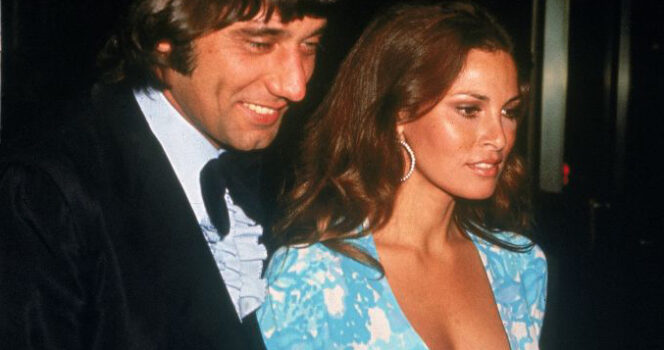
Speaking of wardrobes, Welch’s appearance on Cavett’s stage featured a striking blue gown that sharp-eyed viewers might have recognized. In a move that was decades ahead of the modern “sustainable fashion” trend, Welch was wearing the same dress she had donned for the Oscars just months prior.
She was a quiet revolutionary in the art of the “re-wear.” The gown she wore to the premiere of The Godfather was the same one she chose for Elizabeth Taylor’s 40th birthday bash in Budapest that same year. Welch understood the art of the public image—fulfilling the glamorous expectations of her audience flawlessly—but her personal reality was far more grounded. Away from the red carpet, the “spectacular” Welch was more at home in simple pantsuits and comfortable, unpretentious attire.
Shattering Expectations
One of the most revealing moments of the 1972 interview involved Welch’s reflection on her own “larger-than-life” reputation. She shared a humorous anecdote about meeting sports writers while promoting her roller derby film.
“I had a really interesting press conference… and they said, ‘Gee, you know, you’re a nice-sized lady and all that, but you’re not exactly what I expected,’” she recalled. “And I said, ‘I know—I always seem to disappoint people if I walk in the door and the door hinges don’t splinter off.’”
At a petite 5’5½” with a small-boned frame, the real-life Welch was often a shock to those who only knew her as a towering screen presence. Cavett noted that many people would see her in person and fail to realize it was the star they had seen on the silver screen.
The Voice of an Era
While her olive skin and broad shoulders were the focus of the tabloids, a re-examination of her televised interviews highlights a forgotten asset: her voice. In the digital age, YouTube viewers have rediscovered the “intoxicating” quality of her speech.
-
Articulation: She spoke with a precision and clarity that spoke to her middle-class American upbringing.
-
Presence: There was a “time-stamped” elegance to her cadence—something sophisticated and increasingly rare.
-
Warmth: Despite the “sex symbol” label, she exuded a sweetness and gentleness that felt remarkably approachable.
Welch—born Jo Raquel Tejada to a Bolivian father and an American mother—never lost touch with her pragmatism. She famously described herself as a product of middle-class America, keeping one foot firmly planted in the world outside the Hollywood bubble.
A Legacy Beyond the Frame
The world lost Raquel Welch on February 15, 2023, at the age of 82. While the cause was cardiac arrest, it was later revealed she had been privately battling Alzheimer’s disease.
In an era of filtered perfection and surgical enhancements, Welch stands as a reminder of a more organic brilliance. She possessed a natural elegance—no Botox, no extensions, just a sharp mind and a full-figured, natural grace. To watch her 1972 interview today is to see a woman at the absolute pinnacle of her career, reminding us that while beauty may have opened the door, it was her intellect and character that kept her in the room.